Don’t just read it; fight it! Ask your own questions, look for your own examples, discover your own proofs.
Paul Halmos in “I want to be a Mathematician”
Due to my growing interest in “general abstract nonsense” ever since I found out about Category Theory, I have been both solidifying my fundamental math skills (which were nearly non-existent) using mathacademy’s Math Foundation 1, 2 and 3 but also mapping out the lay of the land, discovering which parts of mathematics interest me the most, trying to connect the dots and going through the incredibly exciting (although sometimes grueling) process of developing my mathematical maturity.
Due to this, I have stumbled upon many books I have enjoyed, some of them I have been going through, some of them I have zoomed through some chapters only and most I will try to write down here in case someone is interested. This list will mostly be for undergrad or above level mathematics, as anything under I believe is well served by MathAcademy’s offering on this (and there are a plethora of precalc and calc books which all seem fairly equivalent to me, maybe due to the nature of the subject).
I will try and break down the recommendations in the following way:
- General books that are useful as references - not to work through anything specifically but that are broad and review or re-introduce important mathematical concepts and can be used as somewhat of a “look-up table” whenever necessary (or a casual evening read with some note-taking if feeling frisky).
- A breakdown per mathematical “branch” with one to a few suggestions
- There will be a bias towards books that include some “categorical” approach to exposition, and obviously the list will be heavily focused around pure mathematics. I have currently 0 interests in formally studying things like PDEs etc.
- I found many wonderful lecture notes on the way, that I will try and add to each section.
One note I want to make is that basically, the only real prerequisites you might need for most of these is some solid foundations of set theory (which most of the books here will introduce in the first chapter, everytime, and is in my opinion enough - I would not recommend a book on set theory itself) and maybe some linear algebra (just because it ensures some level of mathematical maturity and capacity to think about these things, but also because at the end of the day, “linear algebra is the only thing we understand about the world”).
General Books That are “Overall Useful”
The Princeton Companion to Mathematics by Timothy Gowers
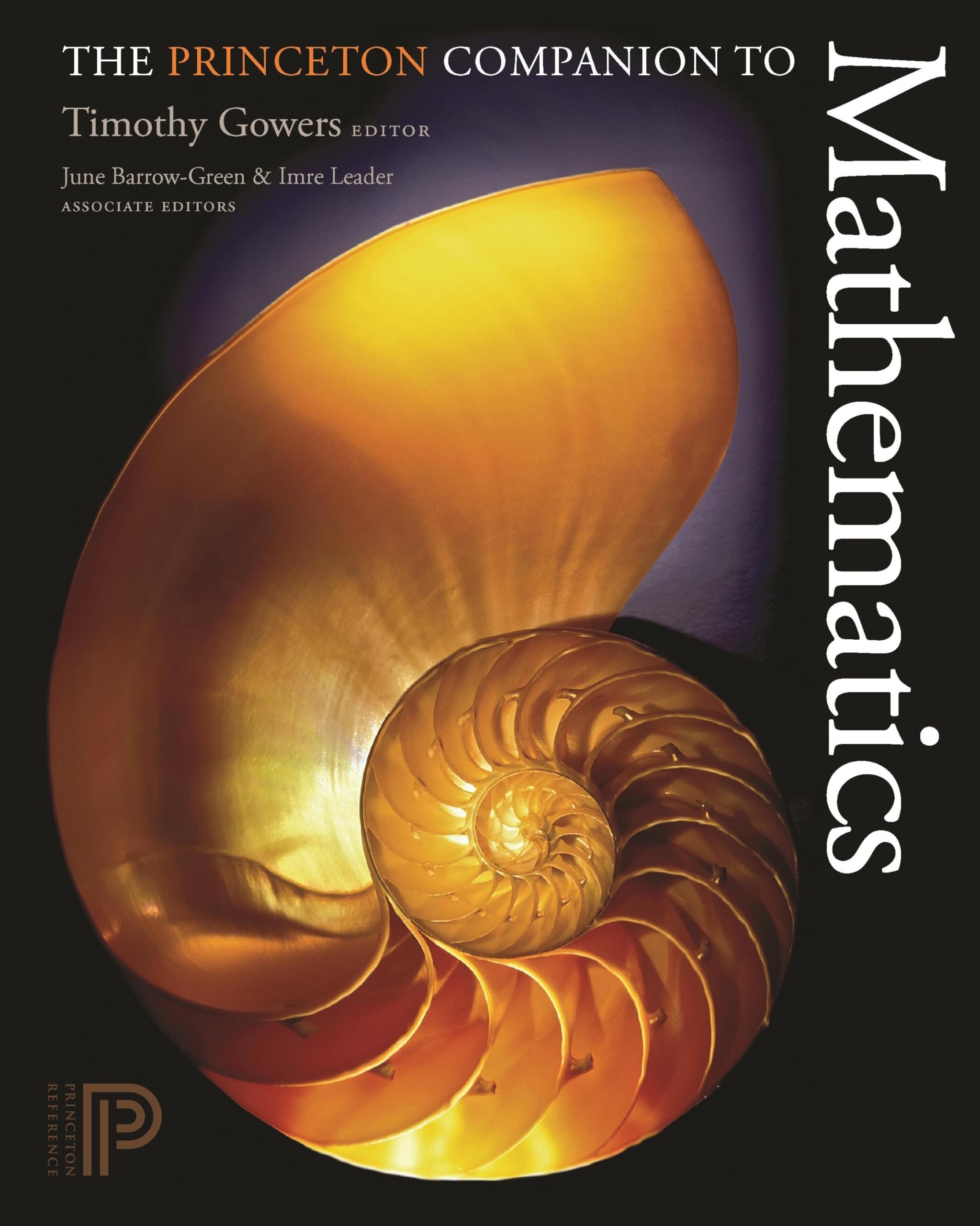
This is the closest to a math bible I have found. A one-stop intro and reference to many mathematical concepts, branches of math (written by leaders in the respective fields, some famous theorems, conjectures and problems, some wonderful and short biographies on many mathematicians (from Fermat to Galois to Cantor to Cayley to Weyl and more).
I would argue just the first ~50 pages, which introduce what mathematics is really about, should be read by nearly everyone out of curiosity. The excellent (if short, although the book is a solid 800+ pages long) writeup on the origins of modern mathematics is also great. I would say I got the most bang from my buck from Part III which covers numerous mathematical concepts (from C*-Algebras to K-Theory, manifolds, varieties, Ricci flow etc…), for two reasons:
- On things I thought I knew, seeing the way it was introduced and connected was sometimes very useful, or at least tested my understanding
- I discovered and learned about many things I did not know were “things” in mathematicsarguably, many such cases… I discover mindblowing mathematical concepts or even entire branches nearly every day, and everytime I believe I have a maybe powerful or interesting idea, I find out people both had that idea a hundred years ago and that there are now 5 sub-fields dedicated to various aspects of it… I discovered geometric complexity theory yesterday ↩︎
I really recommend this book, as a collection piece, as a one-stop glossary of mathematics, as a book to read when you have downtime to discover some new bit of math or to learn about some mathematician’s contribution or atypical life.
All The Math You Missed (But Need to Know for Graduate School) (Second Edition) by Thomas A. Garrity
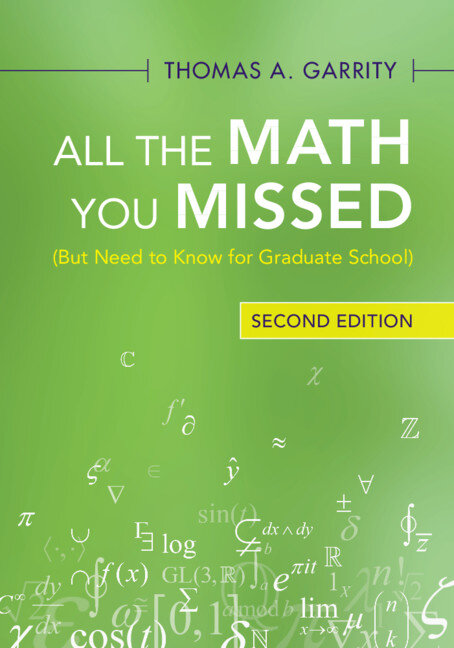
This book has it all and is a very solid “catch-all” option to catch up on undergrad level mathematics. It has some linear algebra, real analysis, point-set topology, some abstract algebra (even some representation theory!), real and complex analysis and by the end, even some category theory. It also has some more applied math, with differential equations, combinatorics etc…
One of my favorite parts is that each section opens with a categorical “summary” of what are the basic “objects” and “morphisms” along with what is the overall basic goal. It does not have a lot of exercises, I don’t believe it offers any solutions, and although the exercises themselves are quite good, the book mostly serves as a very condensed speedrun of the subjects. For subjects that you are interested in truly mastering, this is obviously not enough, but I found this book to be useful to both help me brush up or find my weaknesses around, or open my mind about some mathematical branches and why they might be useful or even necessary for me to keep going.
Mathematical Concepts by Jürgen Jost
Another lovely book! This one I discovered during the Springer Christmas Sale this month, and so is very new. I have not spent a lot of time with this book just yet, but what it does (so far) is do a brilliant job at exposing and diving in very important mathematical concepts such as “spaces” (including what is a space generally, manifolds, schemes etc), “structures”, and overall foundational things like objects, relationships, equivalence, presheaves etc… With my short time with the book, I like that it gives concrete interpretations for most of the concepts, has clear definitions and theorems and once again like every book in this section, covers a very broad range of math things. I do not recall seeing exercises in this book.
Abstract Algebra
Algebra: Notes from the Underground by Paolo Aluffi
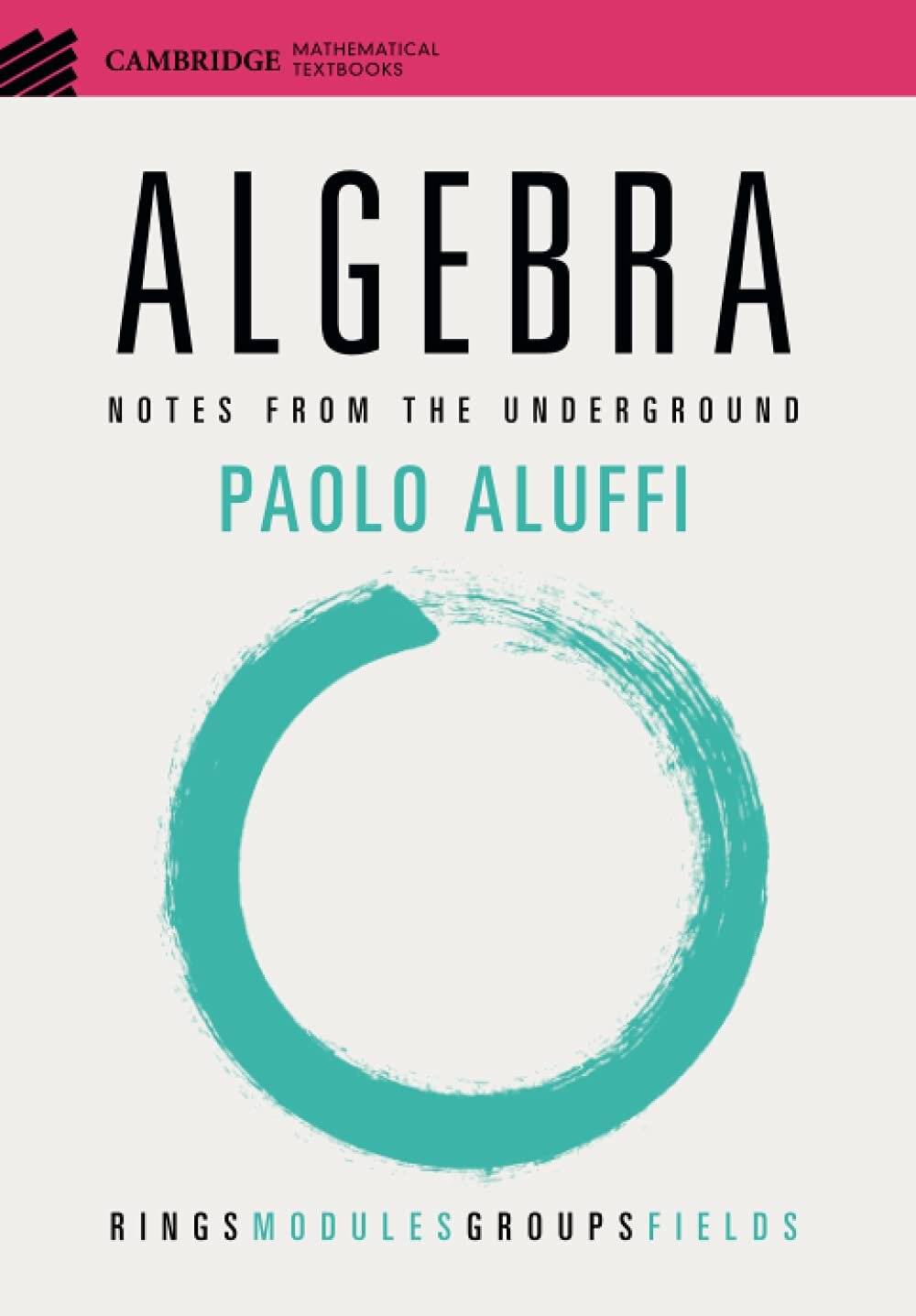
I had heard of Aluffi’s “Chapter 0” very quickly once I decided I wanted to get into Abstract Algebra. It was praised for its categorical approach, how pleasant Aluffi is to read, the quality of the exercises. Unfortunately, being a brainlet, I was skillchecked instantly and could barely get past the “prerequisite chapter on set theory”, as I simply was getting way too ahead of myself and wasn’t mathematically enough. I spent some months on and off with that book and circling back to what I would need to be able to read through it.
On the way, I encountered “Notes From The Underground”, which aims to be an undergrad introduction to Abstract Algebra. It has been a pleasure to go through. It also clearly has a categorical approach, although a lighter one than Chapter: 0, and starts with Rings, on to Modules, then Groups and finally Fields and Galois Theory. I am still on the Modules section, although I went through parts of the Group chapter already. Aluffi is honestly funny and full of personality, and the exercises are very engaging. This is, for now and until I am good enough to deserve Chapter 0, maybe my favorite abstract Algebra book.
Other recommendations
- Obviously, Aluffi’s Chapter 0, if you can handle it! Which is very possible if you’re not a middle school dropout who discovered there is more than CS-brained discrete math and linear algebra before 30 years old.
- I also own Abstract Algebra: Suitable for Self-Study or Online Lectures from Marco Hien, which covers similar things to Aluffi’s Notes From The Underground, but goes about it in a very different way. It spends a lot of time motivating everything and showing
- I also have Abstract Algebra from David S. Dummit, which I mostly try and do some exercises from, from time to time, and open up if I want to re-read a definition or theorem or about a concept in different words. It’s older, a bit more stern, feels more crunchy, but it is very in-depth and feels like it has some nice proofs (for the few I could even get through)
Lecture Notes
- Abstract Algebra notes by Alexander Paulin (Berkeley)
- Math 453 notes by Uli Walther (Purdue)
- Abstract Algebra notes by Steve Doty (Loyola)
- Harvard Extension Abstract Algebra (archived) and accompanying YouTube lectures
Point-set Topology
Topology (Second Edition) by James R. Munkres
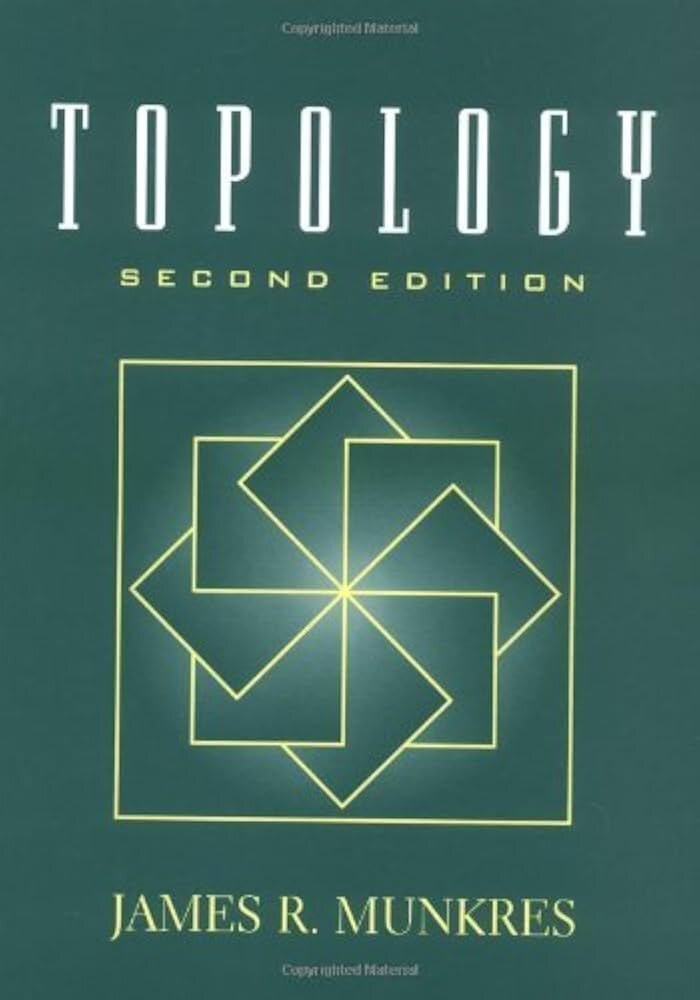
This is going to be a short section because I only have one book on Topology, and it’s Munkres. I found it very, very pleasant, and while I have not worked through the full book (and had already “cheated ahead” by getting into Algebraic Topology last year…), this is basically the perfect book for Topology for me and has everything I need and is pleasant and clear to read if you’re willing to put in some work at times. It also has a wonderful intro to set theory, which honestly you could use on its own to fulfill the requirements of any of the books above, for example.
Lecture notes and miscellaneous
- Topology Without Tears by Sidney A. Moris has been useful, again, to brush up on definitions or theorems and see them put in another way or style or context.
- Hatcher’s notes, which are very dense, is maybe the shortest “speedrun”-like notes I have found.
- I have to give a shoutout to the most insane PDF I have ever seen - I do not recall how I found it, but it is called “Topology” by Stefan Friedl, which is a short 1268 pages… I have not used any of it yet, but it is beautifully formatted and has literally everything I will probably ever need when it comes to topology.
Algebraic Topology
Algebraic Topology presented by Anthony Bosman (Andrews University)
I think this is basically my favorite math lecture of all time. I fell in love with Algebraic Topology instantly last year when I discovered this playlist, coming off a few months of my interest in mathematics starting to really develop. It was mind-opening to me and my first serious look at mathematics outside of the much drier and boring world of algorithms and things like machine learning.
Algebraic Topology by Allen Hatcher
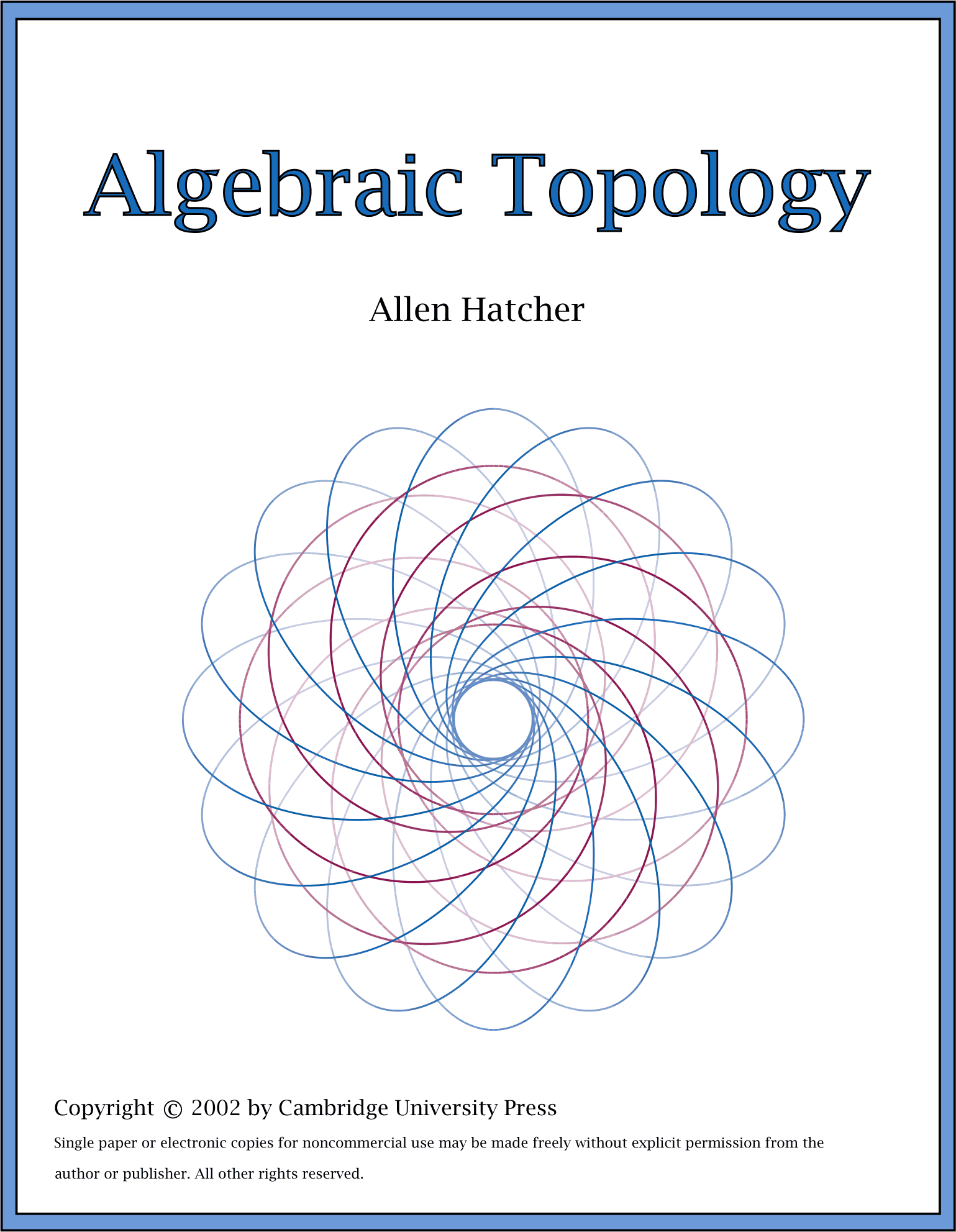
I have not really worked through this book. It is quite beautiful, and there is a lot of supplementary material in there. I don’t know that I really need to go through dedicated book on Algebraic Topology end to end, so, so far I have been using it to look up things that I hear about in the lectures from Anthony Bosman. Another book I heard recommended is “A Basic Course In Algebraic Topology” by William S. Massey, which apparently is less dense and maybe a bit clearer. We shall see.
Notes and Miscellaneous
- Another insane pdf by Stefan Friedl, 767 pages and 49 chapters of Algebraic Topology 1 + 2. I have never even dared read more than a couple lines from it, but it might come in handy someday. You may find it here
Proofs
How To Prove it: A Structured Approach (Third Edition) by Daniel J. Velleman
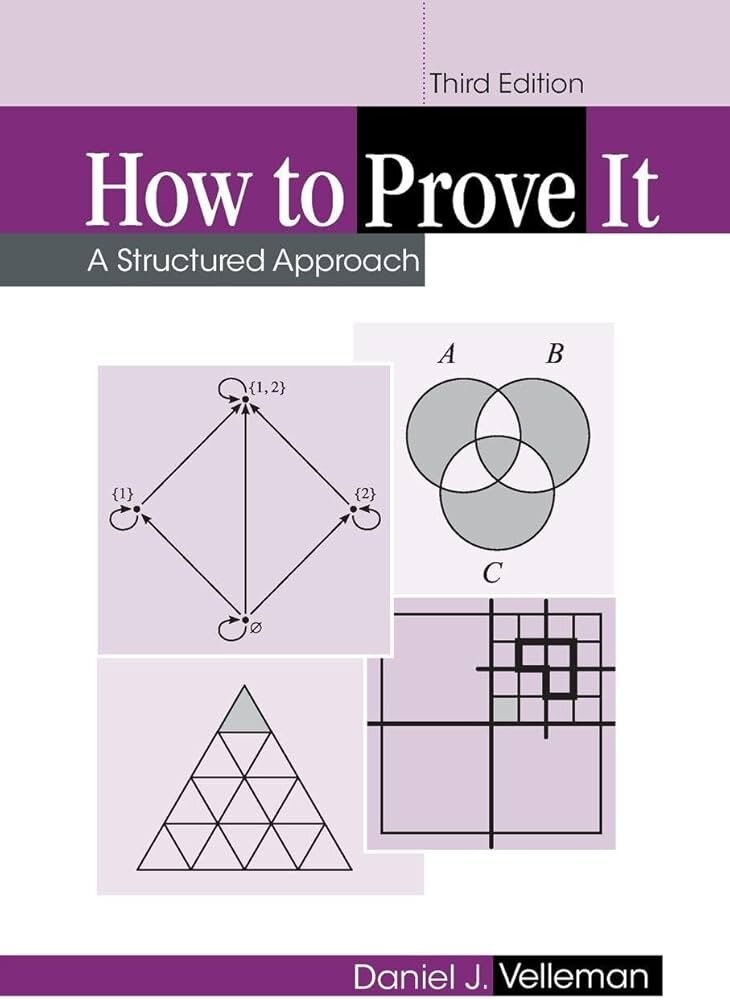
Honestly, I am not super sure that grinding proofs on their own is very useful. However, if you’re completely new to formal, mathematical proof writing (like I was, although I had some solid softer version of these skills from writing a lot of computer programs over the last 15 years, arguably…), How To Prove It has been pleasant and I have found it worth to grind some of it to at least get some solid basic proof writing capabilities. Still, I think it is best to work on your proof skills within the mathematical branches you’re interested in, as there is plenty of opportunity to do so, but if you are completely new to it, then this is a solid introduction.
Book Of Proof (Third Edition) by Richard Hammack

This is a very similar book to How To Prove It. It looks more austere, but has tons of very nice illustrations and is a solid introduction to proofs. It’s also entirely free online. Similar to How To Prove It, it sets up the stage with an intro to sets, logic, counting etc… and then introduces the typical arsenal of direct, contrapositive proofs and proof by contradictions, working its way to mathematical induction and finally reaching functions. It has a huge amount of exercises along with solutions, which is a big plus!
Linear Algebra
Linear Algebra Done Right (Third Edition) by Sheldon Axler
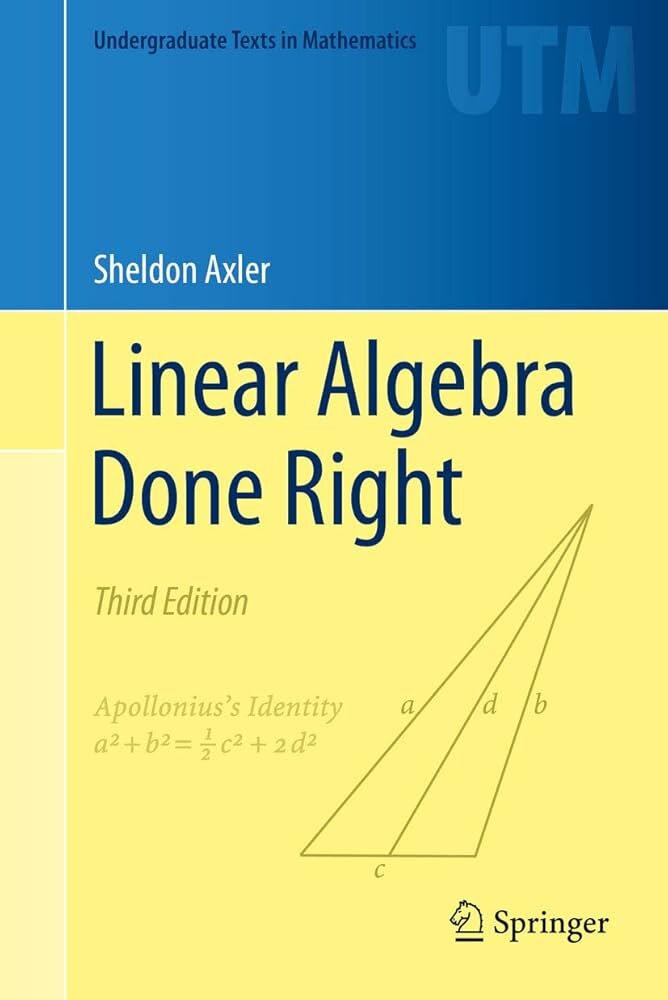
I would say, honestly, it doesn’t really matter what Linear Algebra book you go through. You just need to go through one. Some are more abstract and proof based, some are more applied. I went through “Linear Algebra Done Right” book by Axler a long time ago, and went through some bits and pieces last year again, not without struggle. I think it’s good, and it’s also a much more “pure” approach than some others I guess. I have no opinions on the “determinant” debate at all, to be honest. This book did the job for me.
Essence of Linear Algebra by Grant Sanderson
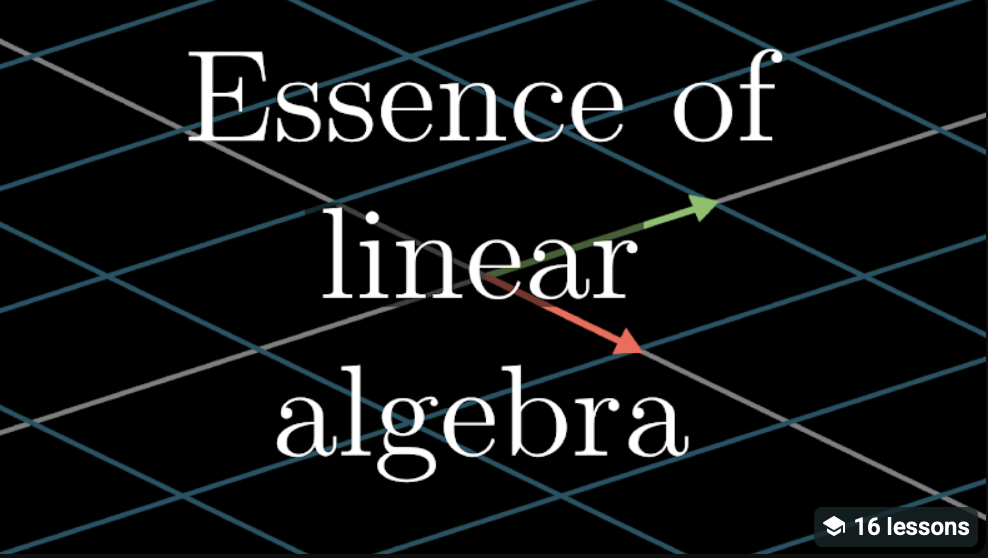
This is a bit out of place but when I was brushing up on my linear algebra skills in 2024, the animations in this series were incredibly useful for me and made a lot of things click. all 16 videos are available in text, along with its animations, on 3blue1brown’s website here
Notes and miscellaneous
- Linear Algebra Abridged is basically Linear Algebra Done Right without any of the proofs examples and exercises. Very useful cheatsheet.
- Some useful lecture notes here from “Math 223 - Linear Algebra 1” by Cesaer O. Aguilar (Department of Mathematics at SUNY Geneseo)
Conclusion
I will be wrapping part 1 here. I do think this is already a great list, but in the next one, I’ll have:
- Category Theory (which will be much less CS-brained than my first writeup here)
- Analysis
For Category Theory there are a few really good entry points and new series of articles I have found that have helped as I got deeper into it, and I basically am analytically illiterate at the moment so cannot form any opinions just yet.
If there is ever a part 3, I imagine I will include more applied mathematics or CS-related related math books, but if I had to make one recommendation now, I would recommend “A Programmer’s Introduction to Mathematics” by Jeremy Kun (find it here), which serves a wonderful purpose of introducing a lot of important mathematical concepts and branches, but from the POV of a computer programmer (along with equations translated into code, which might be substantially easier to dip your toes in). It even covers some group theory fundamentals by the end! It is available with a “pay-what-you-want” model for the ebook version on gumroad here.
I’ll leave you with Terrence Tao’s wonderful and very short essay on “Ask yourself dumb questions – and answer them!” which you may find here.
Footnotes
- arguably, many such cases… I discover mindblowing mathematical concepts or even entire branches nearly every day, and everytime I believe I have a maybe powerful or interesting idea, I find out people both had that idea a hundred years ago and that there are now 5 sub-fields dedicated to various aspects of it… I discovered geometric complexity theory yesterday ↩︎